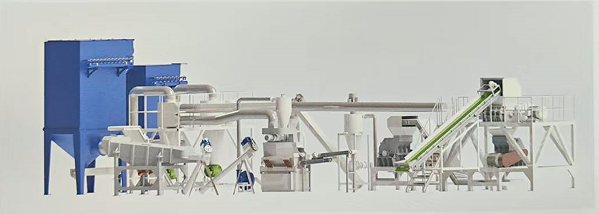
Lithium battery recycling processing equipment
The recycling equipment for spent lithium batteries mainly adopts physical recovery methods, supplemented by "three-waste" disposal measures. It features green and low-carbon, energy-saving and environmentally friendly, and no secondary pollution. It also takes into account economic and environmental benefits. It not only utilizes valuable components but also safely treats harmful components. The entire recycling process is fully automated, with high recycling efficiency and strong processing capacity. The processing capacity per hour is 500 kilograms, and the annual processing capacity reaches 5,000 tons. The recovery rate of valuable components from spent lithium batteries is over 90%. The cobalt, lithium, copper and plastic in spent lithium batteries are all precious resources with high recovery value. Therefore, scientifically and effectively treating and disposing of spent lithium batteries not only has significant environmental benefits but also has good economic benefits.
The scrapped lithium batteries are sent by the conveyor to the first-level shredder for shredding. The shredded materials are then conveyed to the second-level multi-blade crusher for secondary crushing. The materials after secondary crushing are sent into the conveyor again, and at the same time, magnetic separation equipment is set up to separate the iron from the materials. The separated materials are conveyed by the conveyor to the air separation machine, where the separators in the positive and negative electrode sheets separate the separator paper, and the separated positive and negative electrode sheets are sent to the third-level crusher for fine crushing, reducing the material to about 20 mesh. The crushed materials are sent into the cyclone separator by the negative pressure system for dust filtration, and through two air separation processes, different densities of substances are separated. Then, the positive and negative electrode materials and copper, aluminum, nickel and other materials are obtained. All the ultra-fine dust is brought into the pulse dust collector by the negative pressure system for collection. The filtered exhaust gas will continue to be sent by the negative pressure system to the exhaust gas treatment equipment for air purification, so that it can meet the national emission standards before being discharged into the air at a high altitude.
Process flow
The cobalt, lithium, copper and plastic in spent lithium batteries are all valuable resources with high recycling value. Therefore, scientifically and effectively treating and disposing of spent lithium batteries not only has significant environmental benefits but also brings good economic benefits. Lithium batteries are mainly composed of the shell, positive electrode, negative electrode, electrolyte and separator. The positive electrode is formed by coating cobalt oxide powder on both sides of the aluminum foil current collector through the adhesive effect of PVDF; the negative electrode structure is similar to the positive electrode, composed of carbon powder adhered to both sides of the copper foil current collector. Currently, the research on the resource utilization of spent lithium batteries mainly focuses on the recovery of valuable precious metals such as cobalt and lithium with high value, while the separation and recovery of negative electrode materials have rarely been reported. The copper (accounting for about 35% of the content) in the negative electrode sheet of spent lithium batteries is an important production raw material widely used. The carbon powder adhered to it can be used as additives for plastics, rubber, etc. Therefore, effectively separating the constituent materials of the negative electrode sheet of spent lithium batteries can promote the realization of the resource utilization of spent lithium batteries to the maximum extent and eliminate their corresponding environmental impacts. Common methods for the resource utilization of spent lithium batteries include wet gold extraction, fire gold extraction and mechanical physical methods. Compared with wet and fire methods, mechanical physical methods do not require the use of chemical reagents and have lower energy consumption, making it an environmentally friendly and highly efficient method.